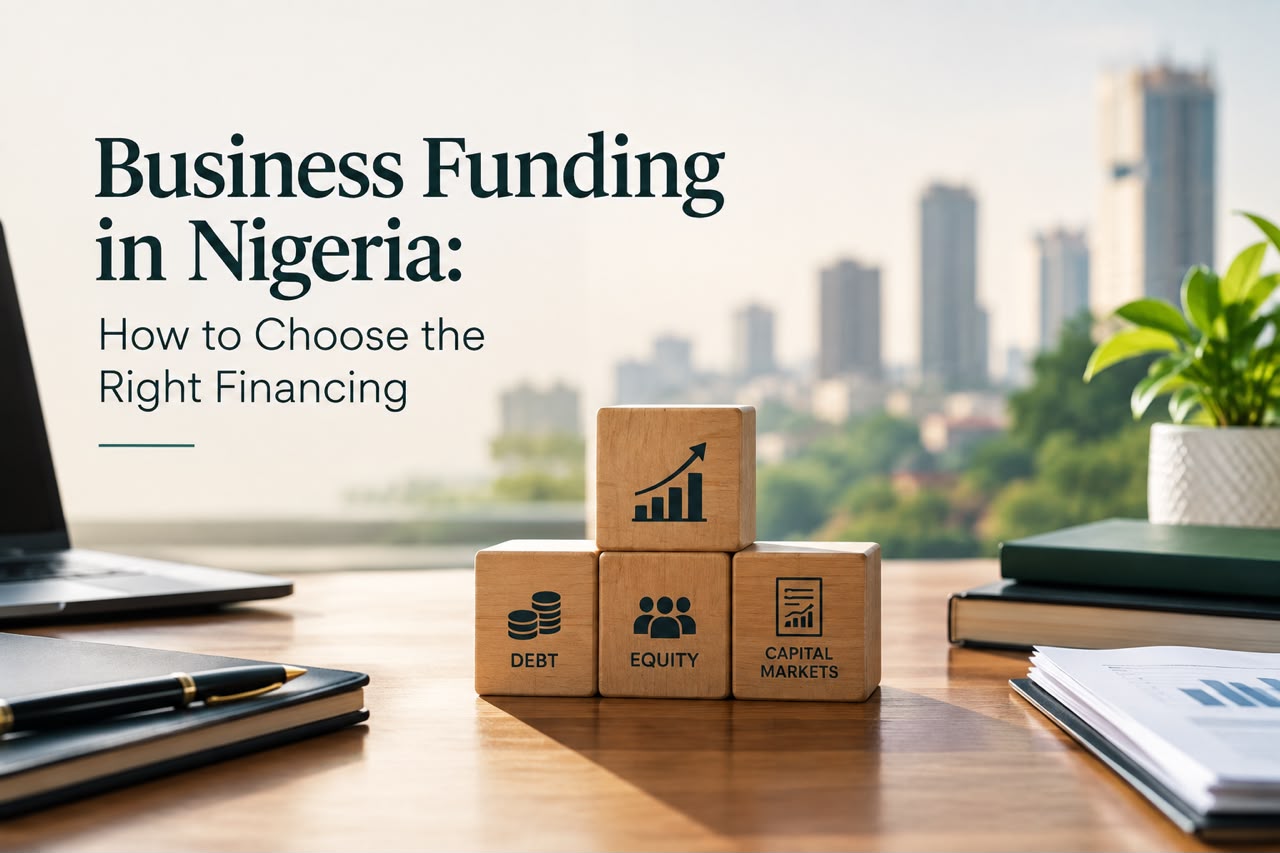
Business Funding in Nigeria: How to Choose the Right Finacing.
Business Funding in Nigeria: How to Choose the Right Financing
When a business needs funding, the conversation often starts with a number.
“We need ₦500 million.”
But how did you arrive at ₦500 million? What exactly will it fund? And what happens after the money comes in?
Those questions matter because the right funding is not simply about getting the money. It is about choosing a financing structure that fits the business, its cash flow and what it is trying to achieve.
Start With What the Money Will Do
Before looking at lenders or investors, be clear about the purpose of the funding.
Is it for working capital? Expansion? New equipment? An acquisition? Refinancing existing debt? Or entering a new market?
The purpose can influence the type of financing that makes sense.
A business with predictable cash flows may be better positioned to take on debt, while a company pursuing aggressive expansion may consider equity if repayments would put too much pressure on cash flow.
The amount also matters. Raising more money than the business can effectively deploy can create unnecessary costs, while raising too little may leave the business returning to the market sooner than expected.
The starting point is therefore simple: know what the money is meant to do.
Debt: Can Your Cash Flow Carry It?
Debt gives a business access to capital without giving away ownership.
But the money has to be repaid, usually with interest. That means the business needs to understand not just how much it can borrow, but whether its future cash flows can comfortably support the repayment schedule.
For some businesses, bank loans may be appropriate. Others may consider asset financing, structured facilities or longer-term funding from development finance institutions, depending on their sector and eligibility.
The cheapest facility on paper is not necessarily the best one. Tenor, repayment structure, interest rate, security requirements and the timing of cash inflows all matter.
A funding decision should therefore look beyond “How much can we borrow?” and ask “What will this debt do to the business over the next few years?”
Equity: No Loan Repayments, But Ownership Changes
Equity financing works differently.
Instead of borrowing money that has to be repaid, the business raises capital in exchange for an ownership interest.
That can make sense for a company with strong growth opportunities but limited capacity to take on more debt. However, bringing in an investor also means sharing ownership and, potentially, some level of influence over the business.
This is where valuation becomes critical.
If you do not have a realistic understanding of what the business is worth, it becomes difficult to assess how much ownership you are giving away for the capital being raised.
The question is not simply whether an investor is willing to put money into the business. It is whether the amount of capital and the ownership being exchanged make sense for both sides.
Capital Markets: A Funding Route Many Businesses Don’t Consider
For businesses that have reached a certain level of maturity, the capital market can provide another route to funding.
Instruments such as commercial paper can allow eligible companies to raise short-term funding directly from investors through a structured issuance, rather than relying solely on traditional bank borrowing.
This route comes with its own requirements. Businesses need credible financial information, appropriate documentation and the ability to meet the expectations of investors and other parties involved in the transaction.
And it is not necessarily something a business should wait until it urgently needs cash to explore.
What this can look like in practice
In our work with a microfinance bank on its funding programme, we helped determine the size, tenor and pricing of the programme.
We coordinated the documentation, including the programme memorandum, pricing supplements and investor materials. We also worked with the issuing house and rating agencies and supported the preparation and engagement of investors through to subscription.
The point is that raising capital involves more than finding investors.
There is the structure, the documentation, the pricing, the regulatory requirements and the investor process to manage.
Before Looking for Funding, Ask If You’re Ready for It
A business may have a genuine funding need and still not be ready to raise capital.
Before approaching lenders or investors, it helps to have a clear picture of the business’s financial position, cash flows, projections, existing obligations and ownership structure.
You should also be able to explain exactly how the funds will be used and what the business expects that funding to achieve.
This preparation matters because investors and lenders are not only looking at the opportunity. They are also looking at the business behind it.
Weak financial records, unclear projections or unresolved obligations can make the funding process more difficult and affect the terms available to the business.
Look Beyond the Money Before You Sign
Getting an offer can feel like the hardest part is over.
It isn’t.
The terms attached to the money matter just as much as the amount being offered.
For debt, consider the interest rate, tenor, repayment schedule, collateral and other obligations.
For equity, consider the valuation, percentage of ownership being offered, investor rights and what the relationship could mean for the business going forward.
The right question is not:
“Who will give us the money?”
It is:
“Which funding structure gives the business the best chance of achieving what it needs to achieve without creating unnecessary pressure later?”
The End2End Perspective
There is no single funding option that is right for every business.
A company raising money for working capital may need a very different structure from one financing an acquisition. A growing business may approach equity differently from an established company with predictable cash flows.
The starting point should always be the business itself:
What are we trying to achieve?
How much capital do we actually need?
What can the business support?
And what are we prepared to give in return?
At End2End Advisory, we help businesses work through those questions, from understanding the funding requirement and assessing financial readiness to navigating financing and capital-raising opportunities.
Because raising money is only part of the job.
The real work is making sure the capital fits the business.
Planning to raise funds for your business? Start with the right questions. Speak with End2End Advisory.