Interest Rates Are Falling. What Should Nigerian Businesses and Investors Do Differently?
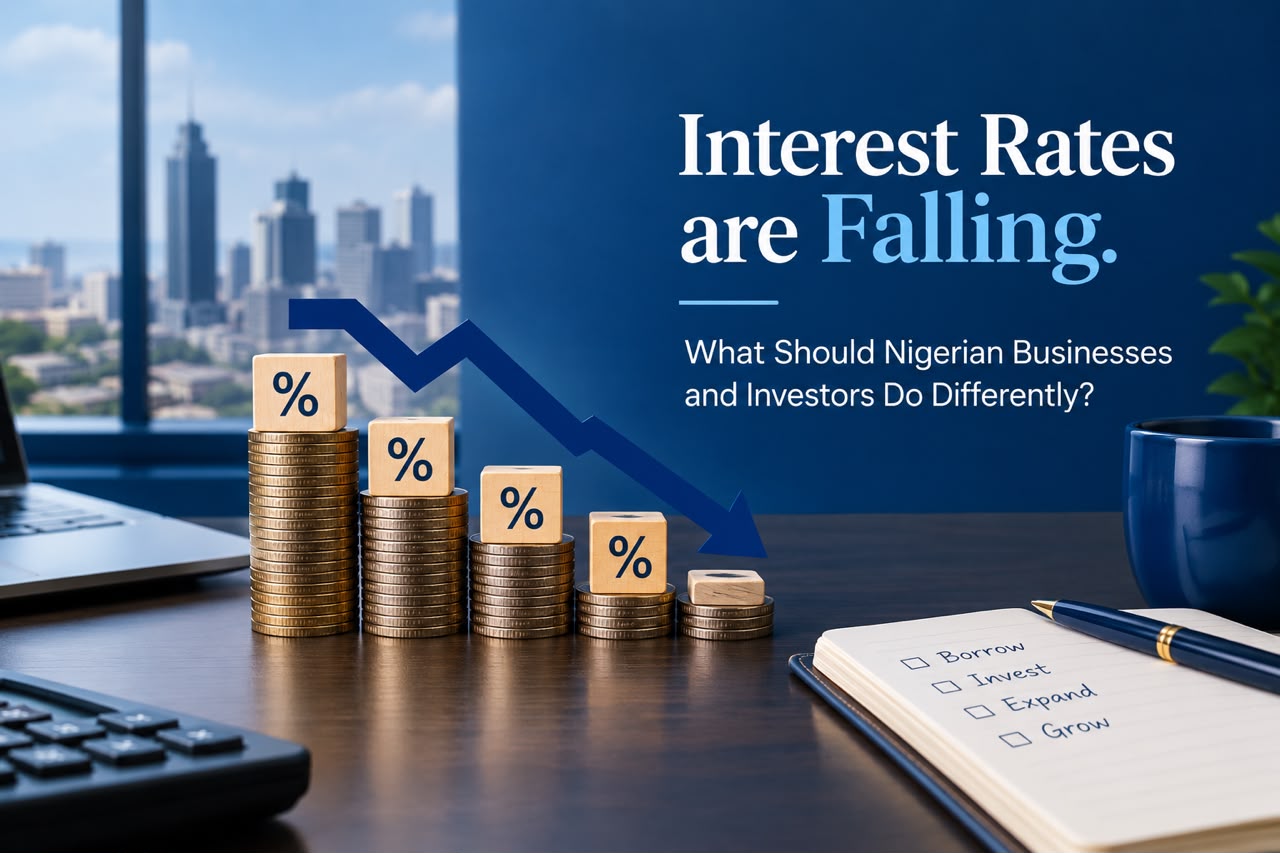
Interest Rates Are Falling. What Should Nigerian Businesses and Investors Do Differently?
For over a year, Nigerian businesses have borrowed, invested and planned for growth in a high-interest-rate environment. That environment is beginning to change.
At its September 21–22 meeting, the Central Bank of Nigeria cut the Monetary Policy Rate by 350 basis points, from 26.5% to 23%, while holding the Cash Reserve Requirement for deposit money banks at 45%. The move comes as inflation eases: headline inflation fell to 15.39% in August 2026, while month-on-month inflation slowed to 0.71% from 1.57% in July.
The obvious question ;“Will rates keep falling?” — isn’t the most useful one. They already have.
The question that matters now is: what should businesses and investors do differently as the cost of money begins to change?
A Lower MPR Doesn’t Automatically Mean Cheap Loans
The MPR is a benchmark, not a guarantee. Actual lending rates still depend on a bank’s funding costs, a borrower’s risk profile, collateral and loan structure.
So the rate cut isn’t a green light to borrow more. It is a reason to re-run the numbers on borrowing.
If you’re considering new equipment, expansion or working-capital financing, the important question is straightforward:
At the new cost of financing, does the investment generate enough return to justify the debt?
That matters more than the headline rate.
Existing Borrowers Should Revisit Their Financing
Companies already carrying expensive debt should review their interest rates, loan tenors, whether their facilities are fixed or variable, refinancing options, early repayment costs and interest burden relative to operating profit.
If lending conditions continue to ease, refinancing could become more attractive.
But refinancing shouldn’t happen simply because a lower rate is available. Fees, penalties, remaining tenor and the actual interest savings all determine whether the move makes financial sense.
The goal should be a better financing structure ,not simply a different loan.
Fixed-Income Investors Are Already Feeling the Shift
The change is already visible in the Treasury-bill market.
At the September 23 auction, stop rates fell across the three major tenors: the 91-day bill cleared at 15.50%, the 182-day at 15.80%, and the 364-day at 15.89%, down from 16.62% for the 364-day bill at the September 9 auction.
For investors accustomed to high fixed-income returns, this increases reinvestment risk: an investment may mature at its agreed rate, only for the next available opportunity to offer a lower yield.
That makes the maturity profile of an investment portfolio increasingly important.
Should Investors Move From Fixed Income Into Equities?
Not automatically.
Lower yields can make equities look more attractive by comparison, but the risk profiles are fundamentally different.
A Treasury bill has a defined maturity and return structure. An equity investment depends on factors including company earnings, valuation and market conditions.
So the more useful question isn’t:
“Should I move out of fixed income and into equities?”
It is:
“Does my portfolio still reflect my objectives, investment horizon and risk tolerance?”
A changing rate environment is a reason to review an investment strategy , not abandon it without considering the risks and trade-offs.
Businesses Should Reprice Old Decisions Too
Projects that looked unattractive under much higher financing costs may now deserve a second look.
An equipment purchase.
An expansion project.
A working-capital facility.
But cheaper financing doesn’t rescue a weak business case.
Demand, operating costs, cash flow, repayment obligations and the expected return on the investment still determine whether a project is worth pursuing.
Lower borrowing costs can change the numbers. They don’t eliminate the need to scrutinise them.
Don’t Ignore Inflation
Nigeria’s August inflation rate of 15.39% is below the new 23% MPR, but prices are still rising. The Consumer Price Index increased from 145.3 in July to 146.3 in August.
For investors, a quoted return only tells part of the story. Inflation, taxes and fees all affect the return that ultimately matters to an investor.
For businesses, easing inflation also doesn’t mean every cost is falling. Energy, logistics, imported inputs and wages can continue to put pressure on operating costs.
The national inflation rate is an important indicator, but it doesn’t necessarily describe the cost structure of every business.
The Opportunity Is to Reassess, Not Just React
The CBN’s rate cut has already shown up in Treasury-bill pricing, with stop rates falling across the major tenors.
But its effects won’t be identical for every business or investor.
For businesses, the focus should be on cost of capital, debt structure, cash flow and the return on new investment.
For investors, it is about reinvestment risk, real returns, portfolio structure and changing opportunities across asset classes.
The businesses and investors best positioned to navigate this shift won’t necessarily be the ones who react fastest. They’ll be the ones who ask the right questions first.
At End2End Advisory, that’s the conversation we help clients have: not whether the CBN’s decision is good or bad, but what it means for their specific numbers, objectives and financial decisions.
The cost of money is changing. Is your strategy changing with it?