Debt Restructuring vs. Refinancing: When should a Business Act ?
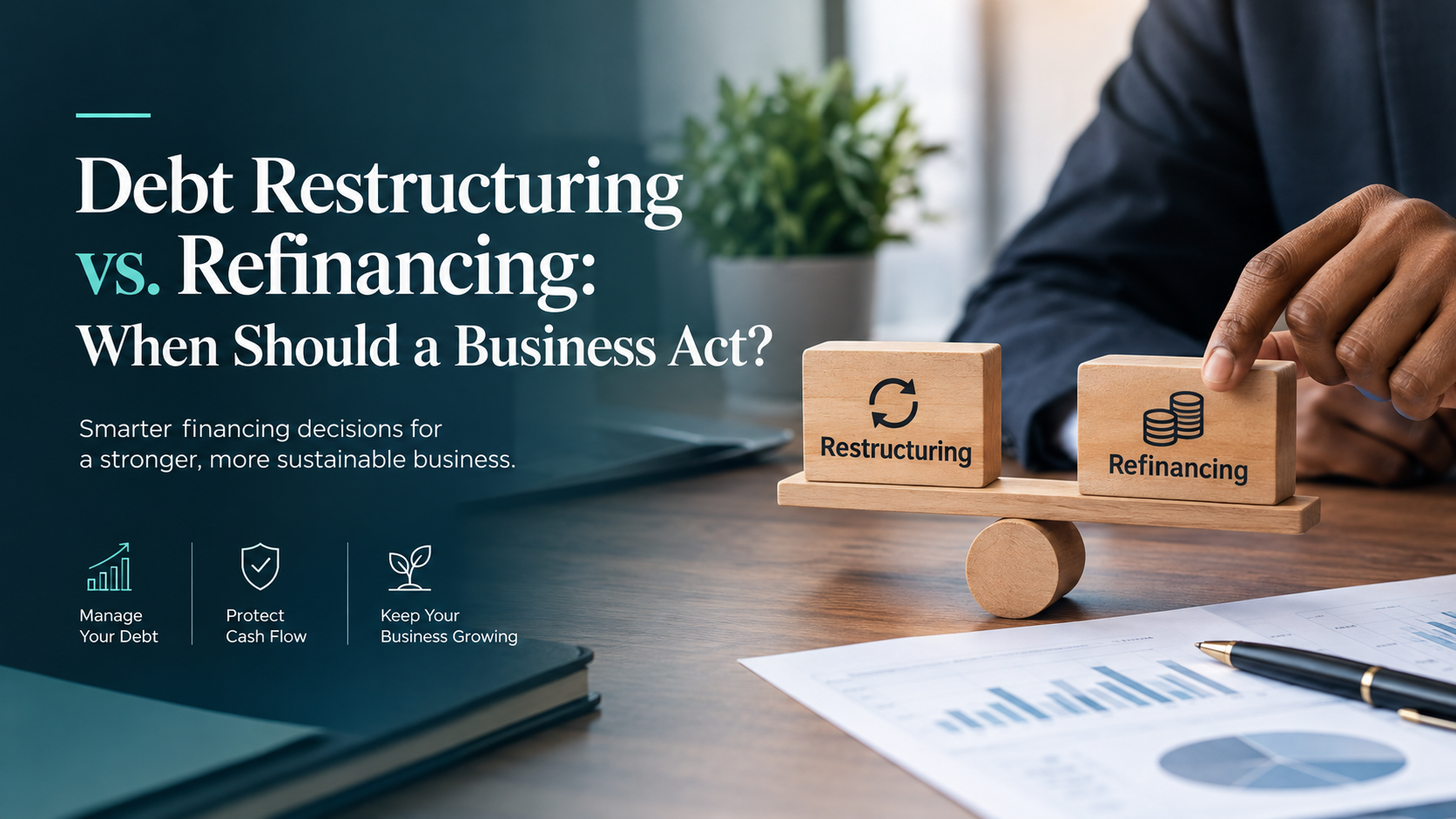
Debt Restructuring vs. Refinancing: When Should a Business Act?
Borrowing can help a business grow, invest in new equipment and keep daily operations running smoothly. But when loan repayments start taking up too much of the money coming in, that borrowing can quickly become a burden.
Perhaps customers are taking longer to pay their invoices. Maybe sales have slowed, operating costs have increased, or an existing loan has become too expensive to maintain. Whatever the reason, a business may find itself struggling to meet its financial obligations while still paying staff, suppliers and other essential expenses.
When this happens, the answer is not always to borrow more money or simply wait for things to improve. Sometimes, the business needs to take a closer look at its existing debt and consider whether a different financing arrangement would be more manageable.
This is where debt restructuring and refinancing come in. Although the two options can help businesses manage their debt, they serve different purposes. Understanding the difference can help business owners decide which approach is worth exploring and when to act.
Signs Your Business May Need Debt Restructuring
Having a loan does not necessarily mean a business is facing financial difficulties. What matters is whether the company can meet its repayments without putting pressure on its day-to-day operations.
There are a few warning signs worth paying attention to:
* Loan repayments are eating into working capital. After making repayments, there is barely enough money left for salaries, suppliers, inventory and other essential expenses.
* New borrowing is being used to pay off old debt. Rather than supporting growth or productive activities, the business keeps taking on more debt to meet existing obligations.
* Payments are becoming harder to meet. The company is struggling to pay lenders, suppliers or other creditors when payments are due.
* Cash flow is becoming unpredictable. Sales may have declined, customers may be paying late, or expenses may have increased, but loan repayments remain the same.
* A major repayment is approaching. An existing facility is nearing maturity, and the business is unsure how it will settle the outstanding balance.
One difficult month does not automatically mean a business needs to restructure its debt. However, when these challenges persist or begin to affect operations, it is worth reviewing the company’s financial position before the situation becomes more difficult to manage.
What Is Financial Restructuring?
Financial restructuring involves reviewing and changing a company’s financial arrangements to make them more sustainable. Depending on the circumstances, this may involve renegotiating loan terms, extending repayment periods, rescheduling payments or making broader changes to how the business is financed.
The goal is to find an arrangement that better reflects the company’s financial position and its ability to meet its obligations.
Consider a business that regularly delivers goods to customers but often waits several months to receive payment. Its income may look good on paper, yet it struggles to meet monthly loan repayments because the money has not arrived when needed.
In this situation, the timing of repayments may be part of the problem. Discussing a more suitable repayment schedule with the lender could help ease the pressure.
Now consider a business whose earnings have fallen significantly and whose debt has become too large for its current level of income. Simply spreading repayments over a longer period may provide some breathing room, but it will not necessarily solve the underlying problem.
This is why businesses need to understand what is causing the financial pressure before deciding on a solution. A change in repayment terms may help, but the arrangement must also be realistic given the company’s expected income and expenses.
Debt Restructuring vs. Refinancing: What’s the Difference?
Debt restructuring and refinancing can both help businesses manage their financial obligations, but the main difference lies in how the existing debt is handled.
What Is Debt Refinancing?
Debt refinancing involves replacing an existing loan or financing facility with a new one. A business may consider this option to secure a lower interest rate, obtain a longer repayment period, change its repayment schedule or consolidate several existing loans.
For example, a company with an expensive short-term loan may explore a longer-term facility with repayments that better match its cash flow.
If the new facility offers more favourable terms, refinancing could reduce the immediate pressure on the business and make repayments easier to manage.
However, a lower interest rate does not automatically mean a better deal. Arrangement fees, early repayment charges and other costs can affect the overall savings. A longer repayment period may also mean paying more interest over the life of the loan.
Before proceeding, the business should compare the full cost of the existing facility with the proposed financing, including the total amount repayable and any additional conditions.
Refinancing also depends on whether a lender is willing to provide the new facility and on the terms available to the business.
What Is Debt Restructuring?
Debt restructuring involves changing the terms of existing debt, usually through an agreement with the lender or other creditors.
Rather than replacing the existing loan with a new one, the business seeks to adjust its current obligations. This could involve extending the maturity date, rescheduling repayments or renegotiating other terms.
For instance, a company experiencing a prolonged period of weak cash flow may realise that its current repayment schedule is no longer realistic. It could approach its lender to discuss whether the repayments can be spread over a longer period or otherwise adjusted to reflect its circumstances.
The outcome will depend on the company’s financial position, the lender’s willingness to negotiate and any conditions attached to the revised arrangement.
Restructuring may provide some relief, but it can also involve additional requirements, changes to existing agreements or requests for further security. It is therefore important to understand the implications before accepting revised terms.
Which Option Is Right for Your Business?
There is no single answer for every business. The right approach depends on why the company is experiencing pressure, how much debt it carries and whether its current financial position can support the proposed arrangement.
Refinancing may be worth exploring when:
* The business can still meet its obligations but wants more favourable borrowing terms.
* A lower-cost facility is available and would reduce the overall cost of borrowing.
* Existing repayments do not align well with the company’s cash flow, and a suitable alternative facility is available.
Restructuring may be worth exploring when:
* The business is struggling to meet its existing repayment obligations.
* Its current repayment schedule no longer reflects what it can realistically afford.
* The company needs to negotiate changes to its existing debt to improve the chances of meeting its obligations.
These are general indicators rather than fixed rules. A business experiencing serious financial pressure may still have refinancing options, while a company in a relatively stable position may need to restructure particular obligations.
Before making a decision, management should review the available options, compare the costs and consider how each arrangement would affect the business over time.
How Can Businesses Protect Cash Flow and Keep Operations Running?
A company can have strong sales and still run into financial difficulties if the money coming in does not arrive when payments are due. When too much cash goes towards servicing debt, there may be little left to keep the business operating.
That is why reviewing the debt alone is not enough. Businesses also need to understand where their cash is going and what can be done to improve their financial position.
A few practical steps can help.
1. Know how much the business needs to keep running.
Start by identifying essential expenses such as salaries, rent, utilities, inventory and supplier payments. This gives management a clearer picture of how much cash must remain available after debt repayments.
2. Follow up on outstanding customer payments.
Late payments can put unnecessary pressure on cash flow. Review overdue invoices, follow up with customers and assess when outstanding amounts are realistically expected to come in.
3. Speak to lenders before the situation gets worse.
If repayments are becoming difficult to meet, engaging lenders early may give the business more time to discuss possible solutions. Waiting until payments have been missed can make the situation harder to manage and may limit available options.
4. Prepare a realistic cash flow forecast.
Estimate expected income, operating expenses and upcoming debt repayments. This helps management identify potential shortfalls before they occur and assess whether a proposed financing arrangement is affordable.
5. Address the issues putting pressure on the business.
If costs are too high, certain activities are consistently unprofitable or customers regularly delay payment, these problems need attention too. A revised loan arrangement may ease the immediate pressure, but lasting improvement often requires changes to the way the business operates.
The aim is to find a financing arrangement that the company can realistically maintain while continuing to meet its essential business needs.
Why Timing Matters When Managing Business Debt
When a business starts struggling with repayments, it can be tempting to wait and hope that sales will improve or outstanding invoices will be settled soon. Sometimes, things do improve. But waiting without a clear plan can leave the company with fewer options if the expected recovery does not happen.
Acting early gives management more time to review the numbers, speak with lenders and assess whether refinancing, restructuring or another approach would be appropriate.
It also helps distinguish between a temporary cash flow problem and a more serious issue with the company’s ability to support its debt.
For example, a business waiting on a major customer payment may face a short-term cash shortage despite having a viable underlying business. Another company may be dealing with falling revenue and debt repayments that remain too high for its current earnings. Although both businesses may struggle to pay their loans, their circumstances require different responses.
Any proposed changes will depend on the company’s financial position and the lender’s agreement. Where the business may be unable to meet its obligations, seeking appropriate financial and legal advice promptly is important.
The End2End Perspective
Debt can be an important tool for business growth, but it needs to be managed in a way that supports the company’s ability to operate and meet its commitments.
When repayments begin to restrict working capital, delay essential spending or put pressure on business continuity, it may be time to review the existing financing arrangement.
The first step is to understand what is causing the pressure. From there, management can assess whether refinancing, restructuring or another financing solution is better suited to the company’s needs.
At End2End Advisory, we work with businesses to assess their financial position, understand the challenges affecting their obligations and explore financing options in line with their wider business objectives.
If your company’s debt repayments are putting pressure on cash flow, it may be time to review your options.
Speak with End2End Advisory to discuss your business’s financing needs and the next steps towards a more sustainable financial position.